Presentation given by Claire Pickard-Cambridge at the Bristol Conference of the Society for Caribbean Studies in July 2025
The work I am going to discuss today was done by Bristol-based former academic historian Julia Bush and myself. We are members of Bristol Quaker Meeting, which is part of a worldwide organisation formally titled the Religious Society of Friends. This Society originated in 17th century Britain, towards the end of the English Civil War, when George Fox drew together a band of preachers and inspired thousands of people to uproot the religious and political authority of the established Church.
The wider context explaining why I am speaking today is that we have studied 14 Bristol-linked Quaker families who built up their wealth from their involvement in enslavement and associated activities during the 1700s in particular. Our findings have proved deeply shocking to us as an organisation, and it is proving a challenging journey for us personally as researchers. Quakers are well known for their role among the leaders in the abolition movement in Britain and highlighted many of the profound injustices that continued after Britain’s Slavery Abolition Act of 1833. But history is not complete if we don’t hold up a mirror to ourselves and acknowledge a dark past when so many Bristolians, including some very prominent Quakers, were benefiting in many different ways from transatlantic trafficking and the chattel enslavement system.
Today’s paper focuses on one of the 14 Quaker families we studied – the under-researched Dickinson family – as part of our wider research into Bristol Quakers and enslavement. Enslavement has left a terrible legacy of inequality that continues today. Therefore, the concluding part of this paper will explain more about this wider research project and how it fits within a worldwide Quaker commitment to addressing the historical injustices of racism, enslavement and colonisation.
Firstly, the foundation of Quakerism coincided with Britain’s 17th century colonisation of the Caribbean and the North American seaboard. So a religious movement which was radical in intention and actions also became deeply involved in the conquest and exploitation of the Caribbean islands, especially Barbados and Jamaica, and in developing colonies in America. This meant involvement in transatlantic chattel slavery.
One consequence was the emergence of a wealthy Quaker merchant class in Bristol. Quakers arrived in the city in 1647 and made many converts among traders and workers. Despite religious persecution after the monarchy was restored in 1660, Quakers succeeded in establishing a strong economic position as a tight-knit community which worshipped and traded together. They were excluded from the then-Church dominated universities and the professions, which encouraged them to employ their own people and invest in each other’s businesses, including in the expanding business of transatlantic chattel slavery.
By the 1730s Bristol was Britain’s main slaving port and by 1807 its ships had forcibly transported nearly half a million enslaved African people across the Atlantic. Some Quakers left Bristol in search of religious freedom and economic opportunity, and this forged transatlantic family links that helped to cement the Bristol Quakers’ trading success. This in turn led to their subsequent success in establishing some of Britain’s earliest banks in Bristol.
Dickinson wealth and key questions
To zero in on the Dickinsons: they were a farming family based originally in Wiltshire but connected to the port city of Bristol through its trading opportunities. Some of their wealth from transatlantic chattel slavery was later invested in a Somerset landed estate, so the family papers have become scattered between county record offices in Bristol, Chippenham and Taunton, in addition to the treasure-trove of Dickinson papers in Philadelphia and possibly others in Jamaica which we have not been able to access. The family is unusually well-recorded and was also unusual in the extent and nature of its participation in transatlantic chattel slavery.
We do not claim that the Dickinsons were ‘typical’ of Bristol Quaker merchants, but they were leading members of their community, and their activities and attitudes throw into sharp relief several key research questions:
• How did Quaker families become involved in transatlantic chattel slavery, and to what extent did their wealth depend upon it?
• How did Quaker plantation owners treat their enslaved workforce?
• How did Quakers who were heavily involved in transatlantic chattel slavery respond to the rising tide of Quaker support for slavery abolition in the late 18th and early 19th centuries?
There is not enough space in a short conference paper to address all these questions adequately, but we can offer brief comments relating to each of them, with a few samples of evidence from the archives.
The Dickinson family had deep connections with transatlantic chattel slavery through their ownership of Jamaican plantations, their merchandising of slave-grown produce, and through their investments in Bristol industries supplying goods to the ‘African trade’ and to Caribbean plantation-owners. In 1655 naval captain Francis Dickinson was granted 6,000 acres as a reward for his role in the British conquest of Jamaica. His son, Caleb Dickinson I, spent much of his life in Jamaica establishing the family’s four sugar plantations through the labour of enslaved Africans. He was also a devoted Quaker, lending his Wiltshire home for Quaker Meetings and receiving fines for refusing to pay church taxes. He traded out of Bristol and was eventually buried in that city. Caleb’s brother, Jonathan Dickinson, emigrated to Pennsylvania where he became one of the Quaker colony’s leading slave traders.
Caleb I’s three sons (Ezekiel, Caleb II and Vickris) jointly inherited the Dickinson plantations of Appleton, Barton, Barton Isles and Pepper Pen, and managed them collaboratively. Caleb Dickinson II was the most directly involved, spending several months in Jamaica in 1757. Caleb II lived in Bristol and was a loyal member of Bristol Quaker Meeting, donating generously towards the rebuilding of the Quaker Friars Meeting House in 1747. His son William became a Member of Parliament and consolidated the family’s status as landed gentry now owning a Somerset estate, but his cousin (Caleb III) and his grandson (William II) remained actively engaged in managing the family’s Jamaican plantations. Descendants of all three Dickinson brothers were beneficiaries of the British government’s £20 million hand-out to the ‘owners’ of enslaved people when British slavery was ‘abolished’ in 1833. The family’s correspondence and account books demonstrate the Dickinsons’ strong intergenerational commitment to expanding their Jamaican landholdings and fostering their wealth through trade in sugar, rum and timber.
This meant a strong commitment to the continuation of transatlantic chattel slavery. Unlike many other Bristol Quaker families, the Dickinsons did not invest directly in slaving ships, but their plantations depended entirely upon the successful exploitation of an enslaved workforce. Family papers reveal how this was achieved. Labour shortages were a problem, especially towards the end of the 18th century when Quaker criticism of slave trafficking was mounting. Although the Quaker national council (Britain Yearly Meeting) had authorised Quaker Meetings in 1761 to expel members still involved in trafficking, the Dickinsons continued to buy and sell enslaved people throughout this period. This included buying some ‘new Negroes’ from Africa, though they preferred ’seasoned Negroes’ and children born on the island.
‘Amelioration’ and its failures
The family considered themselves to be ‘humane’ estate managers, building on a tradition established by their Quaker forebears. In 1709 Caleb I instructed his agent to be ‘very careful’ of his enslaved workers ‘and kind to them; and not work them in the rain nor in the night nor before day in wet weather on no account’. The agent must ‘have always plenty pf provisions that the weak and idle may be supported’ and be ‘always be moderate in correction’. These instructions reflect the advice given by Quaker founder George Fox to Quaker plantation owners in Barbados during his visit there in 1675. However, there was also an underlying profit motive in Caleb I’s orders: ‘Those Negroes that can’t endure labour I had rather sell them than have them drove, whipped to death or abused so that nobody will buy them’. Those who ran away more than once were to be sold to a fellow-Quaker rather than whipped.
The Dickinsons were supporters of ‘amelioration’, or improved treatment, which many Quaker enslavers saw as a viable and morally acceptable alternative to abolishing slave trafficking or freeing the enslaved. Caleb II dispatched a doctor with ‘a compleat apothecary’s chest’ to care for his workforce immediately after his 1757 visit, with an eye to improving efficiency and reducing mortality as well as to reducing suffering. Over the following years smallpox vaccinations were introduced, and various improvements were made to food supply and housing. Above all, the Dickinsons hoped to increase the birth rate on their plantations and thus stem the constant demand for expensive new workers. Caleb’s brother Ezekiel Dickinson wrote to Jamaica in 1779, ‘Should we not as an encouragement and reward give the Breeding Women some additional clothing for themselves and the children?’ In 1785 he urged ‘every reasonable indulgence’ for the ‘lying in women’, including paid-for midwifery support. The chilling term ‘Breeding Women’ introduces the likelihood that many pregnancies were enforced. A further sinister dimension is introduced by the large number of mixed-race or ‘mulatto’ workers on the Dickinson plantations.
The limits of ‘amelioration’ are sadly evident in the continuing poor health and high mortality rates among enslaved workers, documented in correspondence and in an inventory of ‘Negroes and stock’ sent to William Dickinson MP on 1 January 1805. There had been 12 deaths and only 4 births on Pepper Pen plantation in the past year, whilst lists of named men, women and children on the Appleton and Barton Isles estates included people suffering from sores, yaws, ruptures, venereal disease, weakness, blindness and missing limbs.
Resistance by enslaved Africans
Further evidence of failed ‘amelioration’ is supplied by the sustained resistance of African workers on the Dickinson plantations, as on most others. Family letters contain references to ‘insurrection’ elsewhere on the island and (in the 1790s) to ‘the events on St Domingo’ (the Haitian revolution). The Dickinsons were spared a full-scale revolt, but their workers engaged in other forms of resistance to oppression. Family letters sometimes described their African workers as ‘lazy’, ‘refractory’, ‘unruly’ or ‘impudent’. On several occasions enslaved people were found guilty of ‘dirt eating’ – a behaviour which evolved into an act of defiance, though it had roots in West African medicinal practices. In 1757 Caleb II wrote to his agent that he hoped ‘the poor negroes… are reclaimed of the practice of skulking and running away’. Runaways were recorded on lists of the enslaved and in 1779 the Dickinsons ‘paid subscription for the apprehending of sundry Harbourers of Runaway Slaves’ as well as pursuing a legal case ‘for recovery of the negro York’. As Quaker plantation owners, they prided themselves on being kind ‘owners’. But the limitations of the Dickinsons’ kindness are revealed by the execution of one recalcitrant worker at Delacree Pen in 1781. Ezekiel advised his Jamaican agent that ‘if we find this Execution has no good effect (and) that there is no reclaiming them, it may not be amiss to make an example of such a one as is most notorious by shipping him off.’
The Religious Society of Friends debated the issues surrounding enslavement for 150 years before the ‘abolition’ of the British slave trade, then of British slavery. Debate continued into the 19th century over the unfinished business of ‘slavery abolition’ and about how to end enslavement elsewhere in the world. Quakers were at the forefront of these debates, though far from united in their opposition or in their proposed remedies. As Quakers, the Dickinsons would have been aware that an enslaved workforce was controversial. According to the historian Jason Daniels, Jonathan Dickinson ‘disliked’ enslavement in the early 18th century, even whilst building a trafficking enterprise in the enslaved which eventually involved nearly half the members of the Pennsylvania Assembly. Some American Quakers were already voicing moral (rather than economic) objections, but it was not until the 1750s that John Woolman and Anthony Benezet persuaded their Assembly to ban further imports of enslaved Africans.
Quaker divisions
London Yearly Meeting (the British Quakers’ national council) took far longer to act decisively, minuting disapproval of enslavement from 1727 onwards but failing to act against members involved. Even in the 1820s, on the eve of the 1833 Slavery Abolition Act, Quakers failed to agree on immediate and total abolition, and on the issue of compensation for the enslaved rather than for the enslavers.
Bristol Quaker Meeting was also divided and indecisive, but in the late 1780s began to take a leading role in local anti-slavery campaigning. During the same decade Caleb Dickinson II died, giving orders in his will for a small number of enslaved people to be manumitted (or freed). This cannot be interpreted as an incipient family conversion, since in 1788 his brother Ezekiel sanctioned ‘more slave purchases if needed’, with a pragmatic comment on the British Parliament’s failure to pass anti-slave trade legislation. None of the Dickinsons joined the anti-slavery movement, though some of their relatives from other wealthy Bristol families did make this transition. Others from the same dynastic Quaker families drifted away from Quakerism. Neither Caleb nor Ezekiel Dickinson resigned their membership, but the late 18th century leavers included their brother Vickris, his son Caleb III, Caleb II’s son William and Ezekiel’s son Barnard Dickinson.
It is notable that nobody was ever ‘disowned’ by Bristol Quaker Meeting for trafficking or ‘owning’ enslaved people, though London Yearly Meeting gave its official blessing to excluding such members in 1761. The Religious Society of Friends may have become an increasingly uncomfortable place for the Dickinsons, but their continued membership shows that self-congratulatory versions of the Quakers’ anti-slavery history require major revision. Historical research is one facet of a wider review of Quaker involvement in the ongoing legacies of enslavement, colonialism and Empire.
Anti-racism and reparations commitments
The Bristol Quakers’ Black Lives Matter (BLM) group began more actively exploring white privilege and racism following the death of African-American George Floyd in police hands in the US in 2020. This was followed closely by the toppling of the statue in Bristol commemorating Edward Colston, the philanthropist, merchant and trader of enslaved Africans, during BLM protests.
The debates that followed resulted in our Britain Yearly Meeting committing to being an actively anti-racist church in 2021. By 2022 it had committed to supporting reparations for transatlantic chattel slavery.
Following a Bristol Quakers Reparations Conference in 2023, our area meeting reparations group began researching our past, and decided to memorialise and support anti-racist projects in our city.
A reparations workshop held by Bristol Quakers in 2024 was transformative for many of us in terms of our understanding of the process. It was led by Esther Xosei, a leading scholar, adviser and activist on reparations, and brought together Quakers and members of African heritage organisations in Bristol. We have absorbed from Esther that reparations must be far more than just compensation: it should be an ongoing process of education, apology, memorialization and personal transformation as well.
We aim for the repairing and healing of relationships and a greater awareness of how slavery was at the roots of racism and how Bristol Quakers still benefit today. For example, our research into old Quaker papers has found that two old Quaker meeting houses in Bristol, received major contributions from certain Quakers associated with chattel slavery, including the Rogers, Dickinson and Harford families. Land was also purchased for a meeting house by the Bristol-based Fry family, which for about 150 years bought cheap sugar and cocoa produced by enslaved workers in the Caribbean and later (after British abolition in 1833) from Portuguese-ruled Sao Tome.
We have also taken on board from Esther that reparations cannot take place without consulting affected communities – if you act unilaterally you simply replicate the colonial patterns of the past. Since then Bristol Quaker reparations group members have aimed to build relationships with local black-led community organisations involved in racial justice. Some of our committee have been supporting and attending local events related to reparations, such as annual meetings and public consultations organised by the Bristol Legacy Foundation and the Black South West Network, the unveiling of a plaque in Bristol Cathedral honouring John Isaac and the lives of over 4,000 African and Caribbean people who were enslaved by the 19th century Anglican businessman, Thomas Daniel, on his Barbados plantation. We also attended the enslavement gallery re-launch event held by the Rebel Curators at the M-Shed Museum (which I urge people to see while visiting Bristol). Our national Quaker educational organisation, Woodbrooke, is also holding a range of online training courses on reparations and racial justice.
Revealing Research Pamphlet
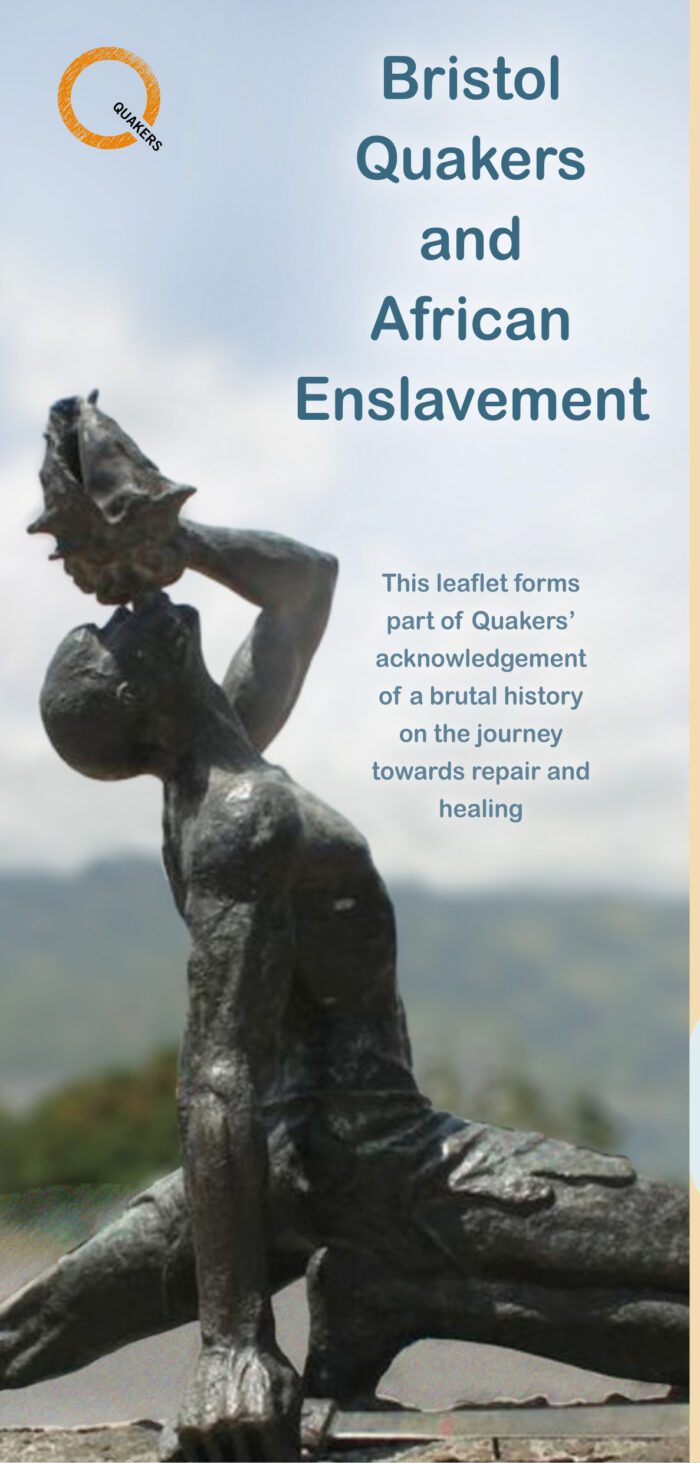
One of our initial steps on the road to reparations has been the production of a pamphlet on Bristol Quakers and African Enslavement, which will be available here at the conference. This leaflet forms part of Quakers’ acknowledgement of a brutal history – we see it as part of the journey towards acknowledgement and education, and in the longer term, apology and repair.
This pamphlet acknowledges the types of Quaker families or individuals we found out about – Champion, Dickinson, Goldney, Harford, Lloyd, Darby, Reeve, Rogers, Scandrett and others. And we included brief stories on African people connected to Bristol Quakers, although details on their lives are sadly much harder to find. We hope to publish a book next year.
Our Quaker reparations group has been talking at different Quaker Meeting Houses in Bristol about our findings. This is part of a national initiative by Quakers and similar research is also happening in other areas in Britain. Dr Nathaniel Adam Tobias Coleman is in the audience today – he was appointed the reparations co-ordinator for the Quakers’ Britain Yearly Meeting, and he is well known as a scholar and activist.
The Lancashire Central and North Area has already erected a plaque of apology in its Lancaster Meeting House to acknowledge that its Quaker Meeting was complicit because it ignored the involvement of members in the trafficking of enslaved Africans. They have published a book on this and their Quaker Area Meeting is dealing with a church reparations action group in Jamaica and possibly the Gambia, in northwest Africa.
In Bristol, we have also so far committed 5,000 pounds in seed-corn funding for a memorial project in Greenbank Cemetery commemorating the life of Fanny Coker, who was born enslaved on the island of Nevis in the Caribbean. She worked all her life for the wealthy sugar merchant and plantation owner John Pinney, who built the grand Georgian House (now a museum) in Bristol. He later freed her, but she was separated from her family when brought to Bristol to continue working for the Pinneys. This artistic memorial project is being spearheaded by artist, playwright and activist Ros Martin, and is supported by the Black South West Network, a racial justice organisation based in Bristol. The memorial is intended to symbolize the lives of so many enslaved women of African-Caribbean heritage, who have endured migration, separation and loss.
Our next step involves planning an autumn conference which will help Bristol Quakers move from acknowledging a past history towards a deeper understanding of the lasting, terrible legacies of enslavement. There will be discussion around a formal apology by Bristol Quakers for their spiritual ancestors’ complicity in enslavement. Further reparative steps will need to be agreed upon by Bristol Quakers and there may be many projects to consider in consultation with local black-led organisations.
For more details, go to the Bristol Quakers’ website…